
Evaluating a fragrance supplier for scale-up is a process audit, not a price comparison. The supplier that wins is the one whose records, testing and communication survive contact with volume — not the one with the friendliest first call. This article turns the evaluation into a scored checklist that a US launch team can run in a week.
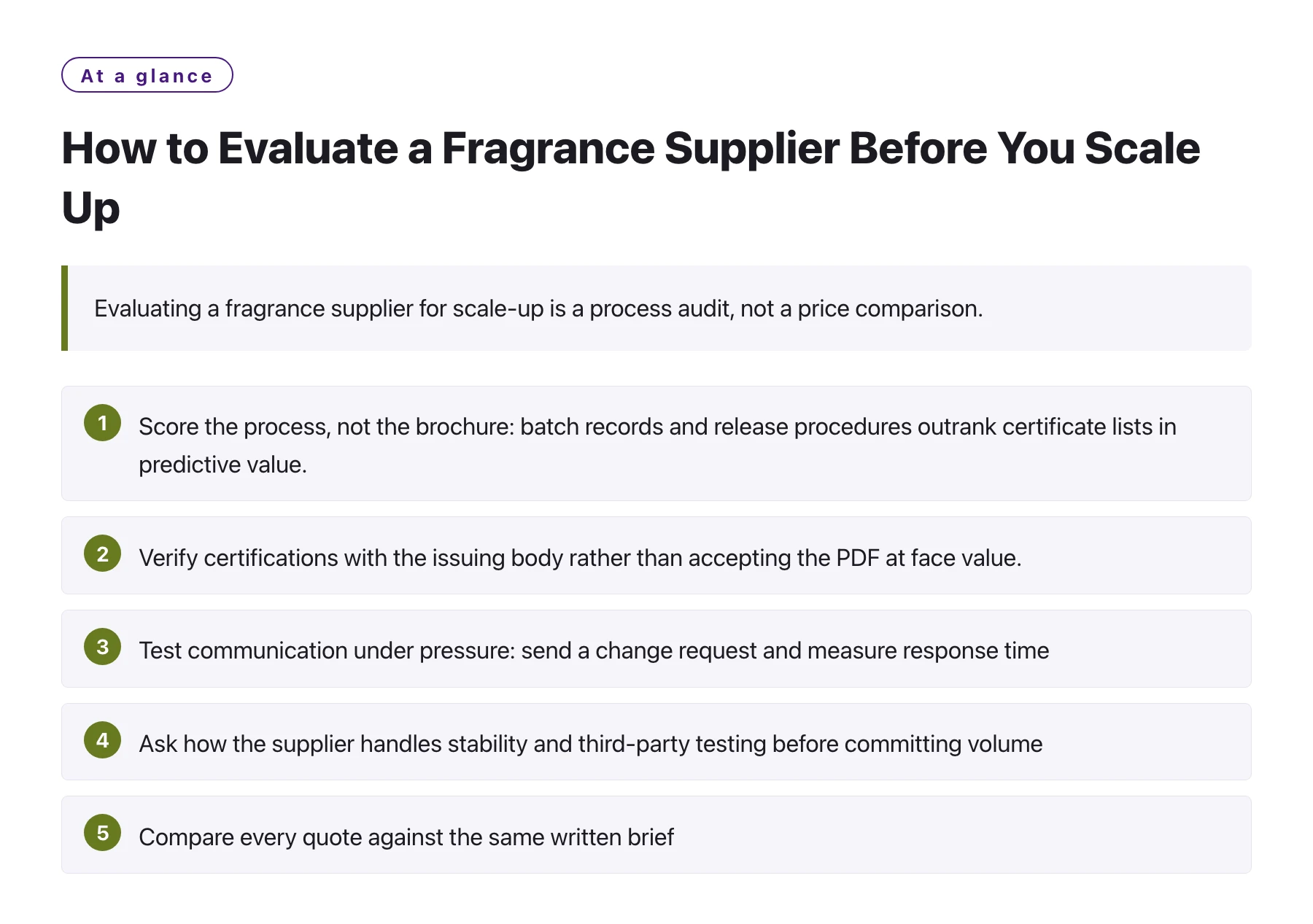
Key takeaways
- Score the process, not the brochure: batch records and release procedures outrank certificate lists in predictive value.
- Verify certifications with the issuing body rather than accepting the PDF at face value.
- Test communication under pressure: send a change request and measure response time, clarity and follow-through.
- Ask how the supplier handles stability and third-party testing before committing volume, not after.
- Compare every quote against the same written brief; otherwise the comparison compares different projects.
Why scale-up changes the evaluation
A supplier can look excellent on a sample and collapse at the third reorder. Scale-up moves the risk from the product to the process: whether the batch matches the sample at volume, whether records exist for every stage, and whether a defect finds a defined response instead of a conversation.
The cheapest due-diligence tool is the supplier's own site. the Xuelei website publishes scope, categories and certifications openly, which means a buyer can form questions before the first call — and suppliers who publish less are asking you to take more on faith.
The scale-up scorecard
| Criterion | What to look for | Red flag |
|---|---|---|
| Batch records | A record per run: raw materials, compounding, filling, release | Records that cannot be produced or walked through |
| Certification | Certificate numbers, issuing body, scope; verify with the issuer | A PDF list with no verifiable numbers |
| Stability and testing | Named testing partner or in-house lab with documented results | 'We'll handle it' with no process described |
| Communication | Fast, structured answers; documented follow-through | Repeated re-explaining; answers that wander |
| Quote consistency | Same brief in, comparable structure out | Quotes structured differently for each format |
| Failure handling | A defined response: rework, replacement or credit | Blame-shifting and improvisation |
Score each row on the evidence, not the promise. A blank row is a red flag by itself.
Running the evaluation in a week
- Day 1: build the briefOne written document: category, formats, volumes, markets, timeline, budget. This is the reference every supplier answers against.
- Day 2: send it to a shortlistThree or four suppliers, identical brief, identical questions. Keep the ask identical so the answers are comparable.
- Days 3-4: score the responsesUse the scorecard above, then add the follow-ups: show a batch record, name the testing partner, describe the defect process.
- Days 5-6: test communicationSend one realistic change request and measure how fast, how clear and how complete the response is.
- Day 7: decidePick on the scorecard, not the friendliest voice. Then put the four decisions — model, ownership, approval reference, document pack — in writing.
The questions that surface weak suppliers
If the launch might switch models later — starting factory-led and moving to a brand-owned formula — find out early whether the supplier supports both OEM and ODM fragrance production, because switching suppliers at scale is expensive.
Show me a batch record
Walk one record from raw material intake to release. Under a cosmetics GMP framework such as ISO 22716, that traceability is the point of the system — a supplier working to it will have the record ready [1].
Who does your stability testing?
The answer should name a laboratory or a defined in-house process, not a shrug. For a US launch the testing list is part of the document pack, so the question is about both quality and paperwork.
What changes at my volume?
Ask for prices and lead times at two or three volumes. A supplier who cannot describe what changes — dosage verification, filling speeds, minimum thresholds, freight — has not thought about your project past the sample.
How do you handle a failure?
The answer reveals the operating character: rework with records, replacement or credit. The compliance side belongs in the same conversation — a statement that the fragrance materials respect the current industry restrictions is part of the pack [2].
Where do the background and the records live?
Two pages of a supplier's site do most of the work here. The about page — its background and certifications — states the history and the management-system scope, and the services page defines the process scope; both are worth reading before any visit.
Sources
- SGS: Cosmetics, Personal Care & Household Testing —— Testing, inspection and certification services for cosmetics and personal care, including microbiological, stability and safety testing aligned with cosmetics GMP.
- IFRA Standards Library (International Fragrance Association) —— The IFRA Standards Library lists the restrictions the fragrance industry applies to individual fragrance ingredients, based on safety assessments; it is the reference point for compliant fragrance formulation.
Frequently asked questions
How many suppliers should I evaluate for a scale-up?
Three to four with an identical brief is usually enough to see the market answer the same question. Fewer and you cannot compare; more and the evaluation loses depth. Score them on process, not price.
What is the single most predictive thing to check?
Whether the supplier can produce a real batch record for a finished run and walk you through it. It combines traceability, documentation discipline and transparency in one check — and it is hard to fake convincingly.
Should I visit the factory before scaling up?
A visit is valuable but not always necessary at small scale. Before you go, ask for the batch record and the testing answers by email; if those are weak, no visit will fix them. Use the visit to verify what the paperwork claims — how production is organised, how records are kept, how samples are retained.
How do I verify a certification is real?
Get the certificate number, the issuing body and the scope, then confirm with the issuer. Certificates are audited claims, and the verification trail behind them is public in a way that matters.
What should be in writing before the first order?
The model (OEM or ODM), ownership of the formula and any mould, the approval sample reference, the document pack for the destination market, and the defect response. Five paragraphs that save months.