
When choosing materials for custom privacy screens, high-density polyethylene (HDPE) boards demonstrate outstanding performance, with an average lifespan of over 15 years and the ability to withstand wind speeds up to 120 kilometers per hour. According to the 2023 Durability Report of Building Materials, the UV stability of HDPE reduces the color fading rate to only 0.5% per year, which is much lower than the 3% fading rate of wood. For instance, in a large-scale residential project in Dubai, the maintenance cost of using HDPE custom privacy screens was 60% lower than that of traditional wooden screens. Its moisture-resistant property enables it to maintain structural integrity even in an environment with a humidity of 90%, with zero risk of corrosion.
Solid wood materials such as Western red cypress offer natural aesthetic value, but they need to be sealed every two years. Their initial cost is approximately 300 yuan per square meter, but their life cycle cost may be 25% higher than that of composite materials within 20 years. A study supported by the American Forestry Association shows that pressure-treated pine wood can achieve a preservative grade of UC4B, extending its ground contact life to 30 years. However, its weight density is 500 kilograms per cubic meter, and additional support structures are required during installation, increasing the budget by 10%. During the 2022 Canadian wood shortage, supply chain fluctuations led to a 15% increase in prices, prompting more people to consider alternative materials.
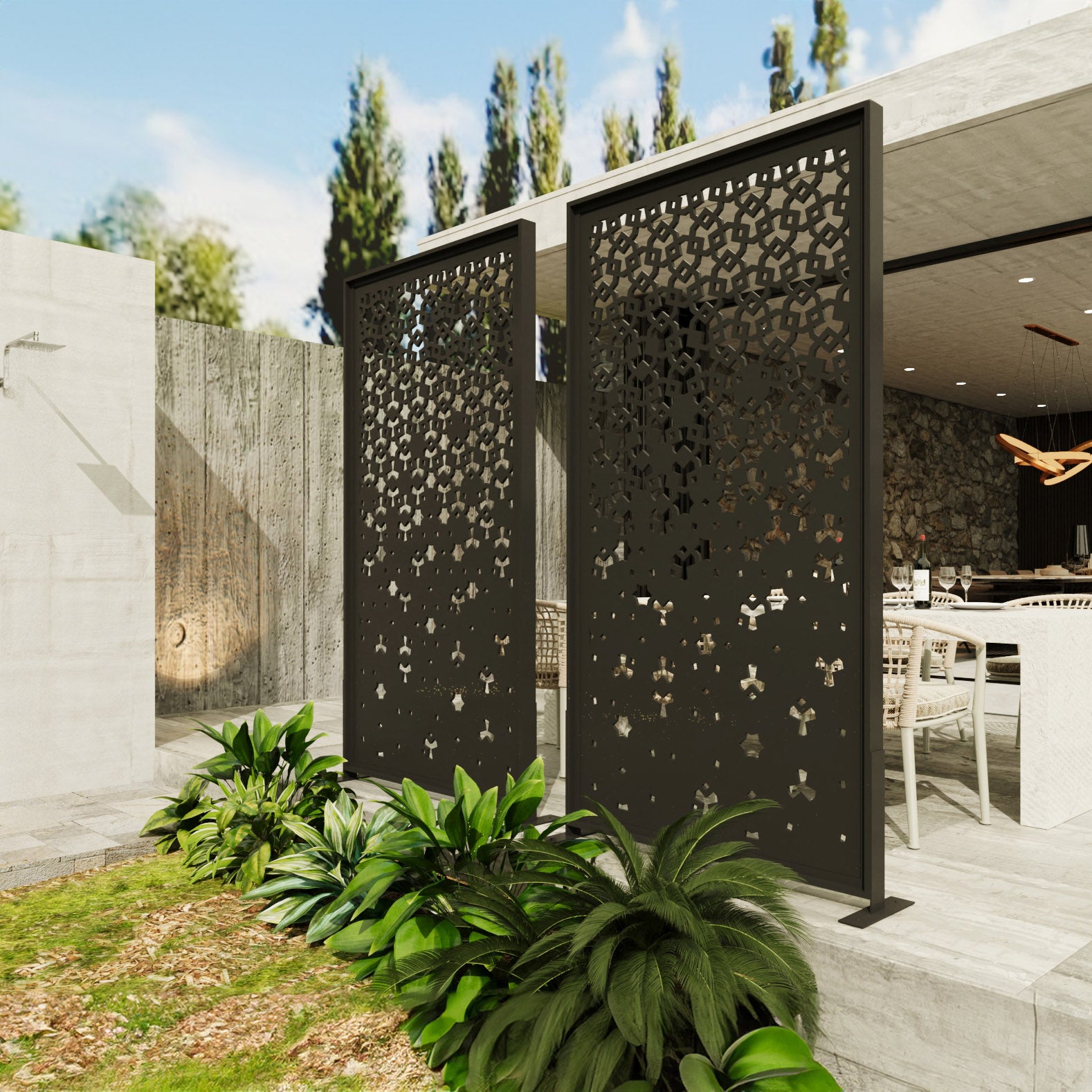 Aluminum alloy privacy screens are favored by commercial projects for their A-level fire resistance rating and 100% recyclability. With A tensile strength of 300 megapascals, a 1.2-millimeter thick board can achieve 95% visual shielding. Referring to the construction standards of the Tokyo 2024 Olympic Village, the aluminum alloy screen has been treated with anodizing to extend its corrosion resistance period to 25 years and increase the installation efficiency by 50%. However, the thermal conductivity of the material is 210 W/m·K, and the surface temperature in summer may be 8°C higher than the ambient temperature. Therefore, it is necessary to optimize it by combining heat insulation coating technology.
Innovative composite materials such as wood-plastic composites (WPC) are changing the market landscape. Composed of 60% recycled plastic and 40% wood fiber, they reduce the carbon footprint of products by 35%. According to tests by the European Building Materials Laboratory, the flexural strength of WPC reaches 40 megapascals, and its coefficient of thermal expansion is only 3×10⁻⁵/° C. Within the temperature range of -30°C to 60°C, the deformation is less than 2 millimeters. For instance, a certain German brand's WPC screen produced through co-extrusion technology has a 30% increase in surface hardness and a fivefold improvement in scratch resistance, maintaining a 10-year quality guarantee in the extremely cold climate of the Scandinavian Peninsula.
The final decision should be based on a precise cost-benefit analysis: the initial price of PVC material is as low as 150 yuan per square meter, but its life cycle is only 8 years. Although the initial cost of glass fiber reinforced plastic is 40% higher, its impact strength reaches 50 kJ/m², and the maintenance cycle is extended to 7 years. As the Housing and Development Board of Singapore's 2023 assessment shows, choosing the right custom privacy screen materials can increase overall project satisfaction by 22% and achieve an 18% return on investment by reducing full-cycle maintenance costs. This demonstrates the strategic value of materials science in outdoor solutions.
Aluminum alloy privacy screens are favored by commercial projects for their A-level fire resistance rating and 100% recyclability. With A tensile strength of 300 megapascals, a 1.2-millimeter thick board can achieve 95% visual shielding. Referring to the construction standards of the Tokyo 2024 Olympic Village, the aluminum alloy screen has been treated with anodizing to extend its corrosion resistance period to 25 years and increase the installation efficiency by 50%. However, the thermal conductivity of the material is 210 W/m·K, and the surface temperature in summer may be 8°C higher than the ambient temperature. Therefore, it is necessary to optimize it by combining heat insulation coating technology.
Innovative composite materials such as wood-plastic composites (WPC) are changing the market landscape. Composed of 60% recycled plastic and 40% wood fiber, they reduce the carbon footprint of products by 35%. According to tests by the European Building Materials Laboratory, the flexural strength of WPC reaches 40 megapascals, and its coefficient of thermal expansion is only 3×10⁻⁵/° C. Within the temperature range of -30°C to 60°C, the deformation is less than 2 millimeters. For instance, a certain German brand's WPC screen produced through co-extrusion technology has a 30% increase in surface hardness and a fivefold improvement in scratch resistance, maintaining a 10-year quality guarantee in the extremely cold climate of the Scandinavian Peninsula.
The final decision should be based on a precise cost-benefit analysis: the initial price of PVC material is as low as 150 yuan per square meter, but its life cycle is only 8 years. Although the initial cost of glass fiber reinforced plastic is 40% higher, its impact strength reaches 50 kJ/m², and the maintenance cycle is extended to 7 years. As the Housing and Development Board of Singapore's 2023 assessment shows, choosing the right custom privacy screen materials can increase overall project satisfaction by 22% and achieve an 18% return on investment by reducing full-cycle maintenance costs. This demonstrates the strategic value of materials science in outdoor solutions.
Aluminum alloy privacy screens are favored by commercial projects for their A-level fire resistance rating and 100% recyclability. With A tensile strength of 300 megapascals, a 1.2-millimeter thick board can achieve 95% visual shielding. Referring to the construction standards of the Tokyo 2024 Olympic Village, the aluminum alloy screen has been treated with anodizing to extend its corrosion resistance period to 25 years and increase the installation efficiency by 50%. However, the thermal conductivity of the material is 210 W/m·K, and the surface temperature in summer may be 8°C higher than the ambient temperature. Therefore, it is necessary to optimize it by combining heat insulation coating technology.
Innovative composite materials such as wood-plastic composites (WPC) are changing the market landscape. Composed of 60% recycled plastic and 40% wood fiber, they reduce the carbon footprint of products by 35%. According to tests by the European Building Materials Laboratory, the flexural strength of WPC reaches 40 megapascals, and its coefficient of thermal expansion is only 3×10⁻⁵/° C. Within the temperature range of -30°C to 60°C, the deformation is less than 2 millimeters. For instance, a certain German brand's WPC screen produced through co-extrusion technology has a 30% increase in surface hardness and a fivefold improvement in scratch resistance, maintaining a 10-year quality guarantee in the extremely cold climate of the Scandinavian Peninsula.
The final decision should be based on a precise cost-benefit analysis: the initial price of PVC material is as low as 150 yuan per square meter, but its life cycle is only 8 years. Although the initial cost of glass fiber reinforced plastic is 40% higher, its impact strength reaches 50 kJ/m², and the maintenance cycle is extended to 7 years. As the Housing and Development Board of Singapore's 2023 assessment shows, choosing the right custom privacy screen materials can increase overall project satisfaction by 22% and achieve an 18% return on investment by reducing full-cycle maintenance costs. This demonstrates the strategic value of materials science in outdoor solutions.
Take the next step
Book a Founder Strategy Call